

You’ve already heard it a ton and you’ll continue to hear it for the next month or so of college basketball coverage:
“It’s early.”
This is said to cautious people against overreacting to anything that has occurred during the first month of the season, and for good reason. Small sample sizes can make for inaccurate conclusions, and of course–players and teams can get better, or in some cases negatively regress.
There is certainly truth in not overreacting to things that happen early in the college basketball season, but that doesn’t mean there can’t be any truth in some of the numbers and film from these early games, especially if a team is playing a good schedule. For example, last year the Gators didn’t play any marquee games in the non-conference portion of the schedule, so it was hard to know if they were padding stats in low-quad games, or if their excellence was for real (it ultimately was, of course). Now, the Gators have played a much more challenging schedule, and therefore we have data that seems much more relevant as it’s against quality competition.
What we’re going to look at today is lineup data–something that longtime Gator Country readers will know I pull from a ton in order to see how players are contributing and what combinations of players are doing better and worse. As we have established, the sample size is small, and this could make for some outlier numbers that should be ignored. However, there could be some valuable information–and while I will certainly weigh in with my analysis, the ball is in your court in terms of what to believe or value and what to ignore or at least wait for more sample size.
A couple of terms you’ll need to know are offensive and defensive rating. These are calculated by using points per possession multiplied by 100. Then, the “net rating” (not to be confused with the NCAA’s “NET” rankings”) is simply offensive rating minus defensive rating. Of course, that suggests a positive net rating is good, and a negative rating is bad.
What I will reference most is a player’s offense or defensive splits, meaning how much better or worse the offense or defense is when a player is on the floor or not. Simply put, if a player has a positive offensive or defensive on/off split, it’s a good thing–it means the team is performing better when they are on the floor. If it’s negative–that means the team is doing worse with that player on the floor.
With all that out of the way, let’s look at some on/off numbers.
Thomas Haugh
I thought I’d start with a bang here, at least when it comes to numbers that look like they could be outliers.
With Haugh on the floor the Gators have actually been -13.7 on the offensive end, which is not good at all. However, they have been +2.1 better on the defensive end. That nets out to a -11.6 split, which shows why these numbers need more context. Haugh is playing like one of the best players in the country right now, and of course no one would suggest that the Gators are better with him on the bench. So, what it likely suggests is that he is in some bad lineups that are underperforming due to other players on the court. Speaking of which…
Xaivian Lee
Sometimes you look at some lineup numbers and see something that shocks you, much like the Haugh data. Other times, the data seems to match the eye test.
Right now the Gators are -17.3 points worse offensively with Lee on the floor and -6.1 points worse defensively.
His -23.4 net splits are by far the worst on the Gators, and suggest a player that is not helping on either side of the floor. Everyone knows that Lee is not playing to the caliber Florida’s staff expected he would, and I don’t mean to pile on, but the numbers are simply tough to look at presently.
Urban Klavzar
Here is another interesting look at lineup data and how it has the possibility to surprise us, like with Haugh, or confirm the eye test, like with Lee.
As a fun exercise, now that you’ve got a feel of how these on/off offense and defensive splits work–what do you think Klavzar’s impact will be?
Three…
Two…
One…
Okay, let’s take a look:
Florida is +12.3 offensively with Klavzar on the floor, and -13.7 defensively.
If you started reading this article with some skepticism about lineup data based on what you saw with Haugh, you’re probably starting to get reeled back in with how Lee and now Klavzar’s numbers are matching the eye test. Klavzar’s +12.3 offensively is the biggest impact any Florida player has, and you can see the spark he has when he comes on the floor. However, the defensive film has been troublesome–and the numbers would back that up.
Alex Condon And Rueben Chinyelu
I thought it would make the most sense to put these two together, as this is another place where lineup data can be interesting–these two players start in the frontcourt together so you’d think their numbers would be quite similar, but that isn’t always the case.
Florida has been +3.3 better offensively with Chinyelu on the court and +8.7 better defensively, making him one of the biggest overall positive players on the roster. For those of you who read my articles last year this might come as a shock, as last year it was Chinyelu who did not look good in the eyes of lineup data, and as the film starts to look much better–as do the numbers.
Condon, on the other hand, has not looked so good. Florida is -8.1 on the offensive end with him on the floor and -0.4 on the defensive end, so not terrible–but it is not the massive positive impact he had a year ago.
Micah Handlogten
While we’re talking frontcourt pieces I should note Handlogten who has a -0.4 impact offensively and -10.3 impact defensively–not numbers that suggest he should be playing a bigger role right now, but again–small sample size.
Boogie Fland
Let’s close it out with Fland, who starts next to Lee who, as you saw, has some pretty brutal advanced numbers. At this point you might be cringing and be ready to see something bad, but that isn’t the case at all.
Right now the Gators are +9.6 points better offensively with Fland on the court and +5.9 points better defensively, and with a +15.5 split margin he is by far the highest impact player (among guys in the regular rotation). Given how many minutes he has played next to Lee–this is truly fascinating. Right now the on/off numbers for these two could not be more different, and it shows that Fland is actually having a massively positive impact when Lee is on the bench.
Getting into different player combinations and seeing who is playing well together will be its own article, but this early look into on/off splits is interesting data as the Gators look at who is contributing positively.
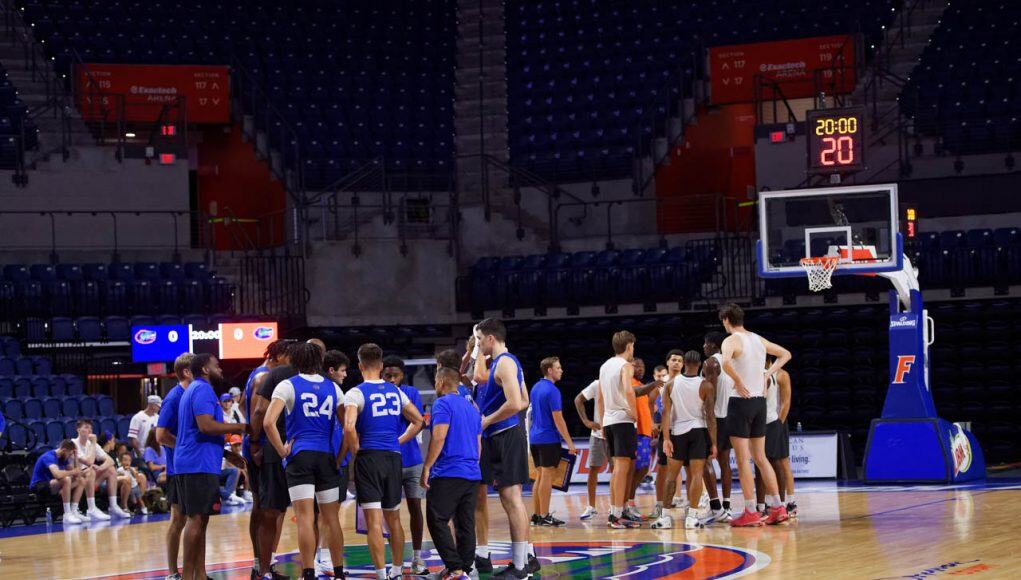
The Florida Gators mens basketball team runs through practice drills during an open practice at Exactech Arena in Gainesville, Florida. August 31st, 2024. Gator Country Photo by David Bowie.