

Throughout Florida’s season there were a ton of storylines, both good and bad. Thomas Haugh breaking out as one of the best players in the sport, Alex Condon and Boogie Fland struggling to make threes, Rueben Chinyelu emerging as one of the most improved players in the country and one of the best defenders, Xaivian Lee struggling to be a creator, the Gators taking some early losses, the Gators stacking up late wins, Urban Klavzar shooting the lights out, and the ultimate early loss in the NCAA to Iowa.
There was a lot going on, and these were just a few of the topics that kept fans and media talking throughout the season that saw the Gators grab a 1-seed and position themselves to potentially win back to back championships.
With so much going on, one storyline was underdiscussed–the quiet breakout of Isaiah Brown. After not playing much as a freshman, some people expected a step forward in year two, but he wasn’t given much opportunity at the start of the season as the Gators tried to get their feet under them against a challenging non-conference slate, including several games where he didn’t see the floor or just got in for a couple of minutes. This started to shift in SEC play where he started to get a bit more of a regular role in the rotation, earning minutes with his defense and ability to knock down an open shot which was what the offense desperately needed. Before you knew it, he was playing 20+ minutes in a couple of games, even staying on the floor in crunch time on a couple of occasions, though those didn’t come by too often with how much the Gators were blowing out opponents.
Brown finished the season averaging 5.5 points and 2.5 rebounds in 12.7 minutes per game, but those numbers don’t quite capture the impact he had in the final months and what he could bring next year that make him a valuable piece.
First of all, one of the biggest boosts Brown made to the roster was simply the fact that he was a 6’4” wing who could guard opposing small forwards, something the Gators didn’t have much of. With the roster build, Florida didn’t leave themselves many opportunities to have depth past the concept of Thomas Haugh playing the “3.” In the summer the staff were convinced that CJ Ingram was going to be able to contribute right away in that spot but he ultimately wasn’t at that level, and Florida just didn’t have long, athletic bodies that fit at the spot–other than Brown. Perhaps his 6’4” frame isn’t as long as your prototypical SEC wings, but Brown’s powerful frame and athleticism allowed him to play the role perfectly.
Given that Florida was all about defense, Brown knew he could earn a spot with his tenacity. The Gators were a faster, more versatile defense with him on the floor, and the advanced numbers love what he brought to the team defense as well as on the individual side where opponents were at just 0.77 points per possession when hounded by Brown. The SEC is loaded with talented scorers at the wing so it should also be noted he was often guarding the opposition’s best player, making this number even more impressive. Looking towards next season the Gators didn’t bolster their wing rotation much. Denzel Aberdeen brings more length than Brown but he isn’t as physically strong, and it will be interesting to see who the Gators see as a better stopper at the wing as Aberdeen is more used to chasing around smaller guards through ball screens.
Another key element that Brown brought to the Gators was shooting for a team that desperately needed it. On the season Brown was 35%, a decent number that was excellent compared to many of his teammates, but perhaps the important number to look at here when projecting to next season is conference play. In SEC games Brown shot 13-31, or 42% from three, and that’s a number that could be elite if he could come close to maintaining. Yes, the sample size is small so it’s not fair to suggest he will clearly maintain it next season, but it showed he was able to hit shots against quality opponents for the last few months of the season and that will be something to monitor going into 2026-27. Florida is banking on improved shooting coming on internal development, and if Brown is able to be an above-average three-point shooter he is going to continue to command a big piece of the rotation.
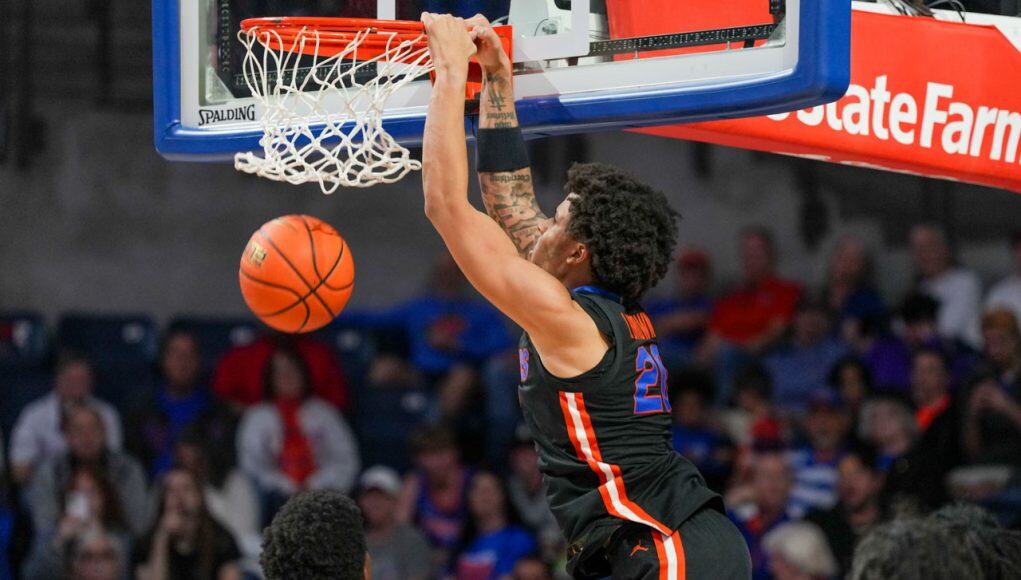
Florida basketball was all about pace last season and Brown thrived on the fast break. One third of Brown’s shots came in transition, and many of his made threes came on the break. In fact, Brown shot 43% on transition threes, first using his speed to get to spots early and create open looks for himself where he was able to capitalize. A fairly explosive athlete, Brown finished the season with 24 logged dunks–pretty impressive for a guy who played 13 minutes a game in 33 games, and many of these slams came on the fast break.
For Brown, the next area of development needs to be utilizing some of the kick-out and off the swing opportunities to attack a closeout and get downhill where he can use his athleticism not just in transition but the half court. This was a weak point for Brown who still needs to clean up his handle and improve his decision-making, but it also should be added that this wasn’t a major area of strength for the entire roster partially due to the style of play and spacing. Since the Gators were all about size and offensive rebounding their two-big lineups were not all that conducive to driving lines, and there often wasn’t opportunities for players like Brown to drive because if they did it would go directly into a help defender or where someone like Chinyelu was posting up on the strong side.
The word around the program is that the Gators want to play a bit smaller this year in order to get Alex Condon more minutes at the “5” and Thomas Haugh more minutes at the “4.” In order to do this, they will need the wings they do have to play a bigger role–and that’s where it looks like Brown is primed to take a step up. If Haugh plays more minutes at the “4” than a lot of minutes at the “3” will have to go to Brown, Aberdeen, and Ingram (at least as the first options), and Brown is the most natural fit at that position. Also, if the Gators end up playing smaller there should be more opportunities for wings to attack closeouts and drive and if that happens and Brown is able to improve his game attacking off the catch he could be primed for a breakout.
Simply put, Florida needs more versatility from their wing group from last year and they need players who can make shots, and Brown could be the guy best suited to do it. His minutes quietly crept up throughout the season last year and he finished the season as one of the most important bench pieces and that role could increase even more this year.