

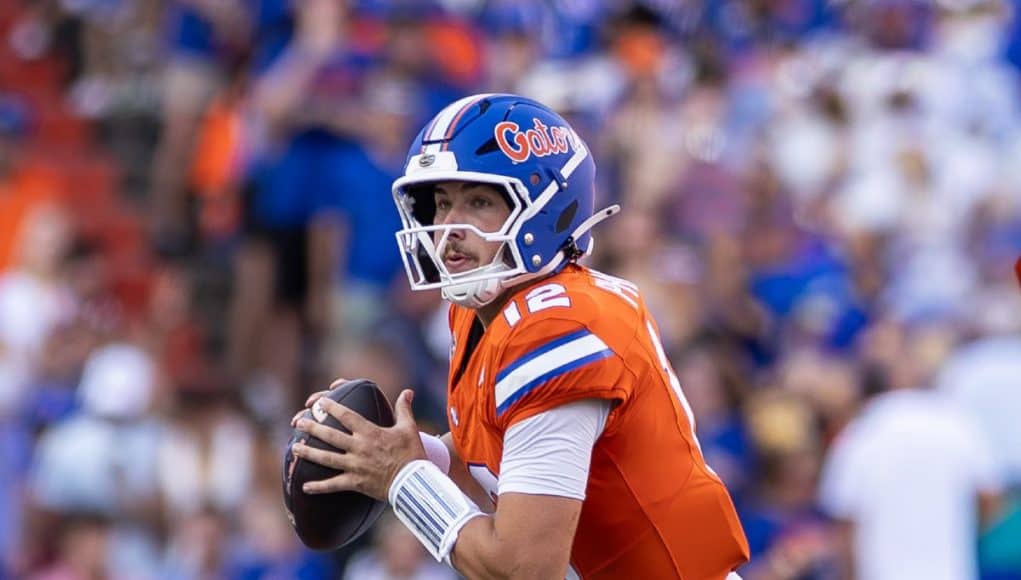
Florida won an action-packed road tilt over Auburn by a score or 44-39. Before picking it apart too much, it’s worth noting that it was only UF’s sixth win at Auburn in the last half-century. Steve Spurrier did it four times, Galen Hall did it once in 1985, and then there was tonight.
Yes, it also was the Gators’ first game on the Plains in 15 years, which the new nine-game SEC schedule fixes. They won’t go more than four years without playing at any SEC site, Athens excepted of course. But still: it was also just UF’s ninth win at Auburn ever; previously the team was 8-27-1 there.
So given that it was a new staff, and it was the new staff’s first P4 game and first SEC game and first road game all rolled into one, and the team has a first-year starting quarterback, and the opponent had already been tested with a peer opponent, there’s only so much I’m going to complain about here. Road wins worth bragging about have been at a premium lately, and though AU is not a playoff contender, it’s not a bad team either. That was a good win.
That said, it also was never a comfortable win despite Florida having a three-score lead halfway through the fourth quarter. And also despite the win expectancy chart never dipping below 49% at any time or below 80% in the final 28 minutes of the game.
Jon Sumrall never directly addressed his end-game management in his postgame press conference, so what follows is my own informed speculation. Take it for what it’s worth.
It looked to me that after Florida went up 34-17 a little past the midway point of the third quarter, the UF side decided to try to win not by putting the opponent away but rather by playing a game of chicken with the clock. They won, and that is the goal after all, but the margin ended up slimmer than perhaps it needed to be.
That key touchdown drive looked a lot like other drives in the game, not least because each team was penalized on it. There were 12 called plays, one of which was negated for a hold. There were eight called runs and four passes, a 2:1 rush-to-pass ratio. Changing the official stats so that two sacks convert from rushes to passes and excluding the final kneel-down, UF had 50 rushes to 25 passes, which is exactly a 2:1 ratio. I can’t remember how many of Aaron Philo’s carries were scrambles on called passes, but it wasn’t enough to get too far off that ratio.
After that drive, again not counting the game’s final play, Florida had 14 rushes to only three passes. That’s 82% running, if you’re counting along at home. It also means that the run/pass mix before was actually 36 rushes to 22 passes, or about 62% run.
The run rate was 20 percentage points higher on the final three drives compared to all that came before. Florida still scored ten points because Jadan Baugh broke a 53-yarder and another drive was on a short field after a failed Auburn onside kick. They might’ve scored on all three series if not for a delay of game penalty on a field goal try that then turned into a punt after another failed onside kick.
The defense also appeared to take a turn after the score to go up 34-17. I can’t say for sure how much changed, but it looked like a lot of stuff designed to prevent a big play. By that, I mean there were a lot of uncontested catches with almost no yards after the catch. It’s what you’d expect to see when a defense is trying to keep everything in front of them.
Fortunately, the defenders were actually wrapping up and not allowing those yards after the catch. They were not, however, always keeping track of Byrum Brown, which contributed to the comeback attempt. But in general, the only time you saw someone breaking up a pass, it was on a deep throw. It was different than earlier in the game when underneath stuff would be challenged by DBs too.
Again: it worked. It would’ve worked even better if they didn’t keep losing contain on Brown. It took a drive longer than it should have, but Patrick Durkin nailed the field goal that ultimately put the game out of reach. Auburn did eventually run out of time.
On the defensive side, I would be curious to know if that strategy was what they think they have to do with this roster or against that opponent or some mix of both. If the Gators have more modestly large second-half leads against good teams, we’ll maybe find some of that out.
On the offensive side, I do wonder if some adjustment needs to be made based on game play versus practice.
Football is one of many sports where in crunch time, you’re supposed to give the ball to your best players. Florida’s best is Baugh, and he helped win the game with his long touchdown in the fourth quarter.
However, Vernell Brown III and Dallas Wilson might be Nos. 2 and 3. Unless they’re going to do a horizontal play like a jet sweep or pop pass, the way to get them the ball is via Philo’s arm.
In preseason camp, Gator Country and plenty of other outlets reported that one of the key factors of the quarterback battle between Philo and Tramell Jones was taking care of the ball. Both guys struggled with throwing interceptions. If that memory of late August is still fresh in the coaches’ minds, then going super run heavy late to ice the game makes a ton of sense.
However, Philo has taken great care of the ball so far. By my count, he’s thrown a single dangerous pass in three games. FAU jumped a route in the opener, and with a little better timing, it could’ve been a pick.
Both actual picks Philo has thrown hit a receiver in the hands before popping up in the air. He’s failed to see some open receivers, skipped a pass or two, and just missed guys occasionally. But actual danger? Very, very little. Plus he’s seeing the rush well, moving around the pocket as needed, and not getting himself blindsided.
It may be time to acknowledge that Philo himself is one of the best players on the offense. Baugh still reigns supreme, no question. But Philo is up there, and he’s the conduit to getting the ball to Brown and Wilson.
I’m not at practice, and I can only go on what I see on Saturdays. I’m ready to see a bit more trust in Philo when the game is on the line, though.
If this all sounds like being too critical after a big win, consider that the head coach himself said, “[i]f we play like that, we will get just slaughtered.” I’m not going that far. I just want to see a three-score margin in the fourth quarter be something that the team looks to extend rather than preserve. Part of that is probably giving somewhat less cushion to opposing receivers, and perhaps more of it is giving Philo a bigger chance to make plays down the stretch.