

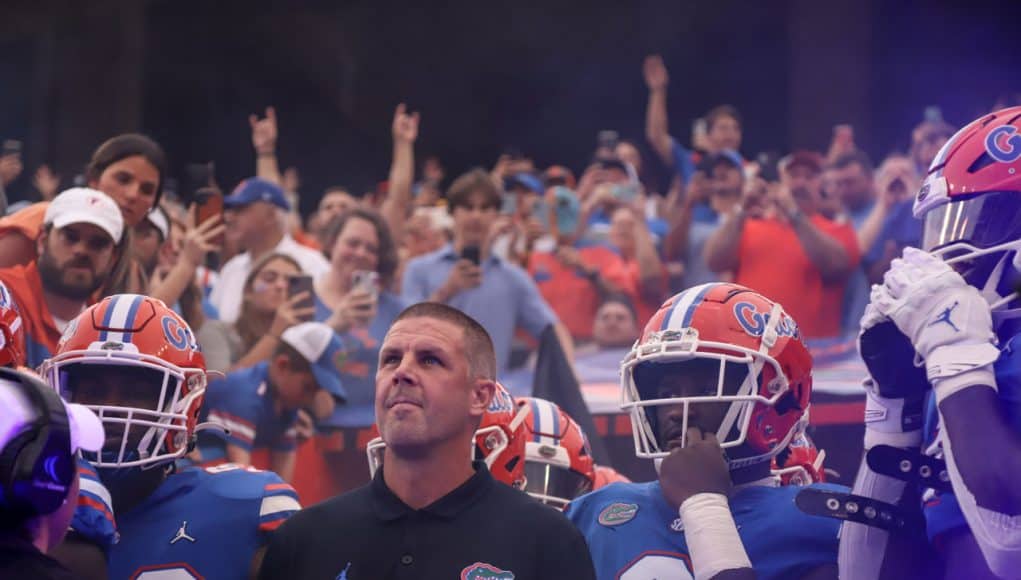
It’s finally happened: after more than a year of intense hot-seat speculation, Billy Napier is no longer the head football coach at the University of Florida. There will be some time this week with an open date coming up next Saturday to reflect on his tenure to find all the lessons to be learned from it.
However, Scott Stricklin and anyone else involved in the search for a replacement should not spend too much time looking backwards. Their eyes must be focused on the future if the program is to return to its past heights.
UF has had its best success when being future-focused. Steve Spurrier’s Fun ‘n Gun offense presaged the explosion of passing offense across college football. Upon Urban Meyer’s hire, there was debate as to whether his cutting edge spread option attack could work in the SEC. Not only could it work, but it thrived.
But as Pixar co-founder Ed Catmull famously said, success hides problems.
Spurrier was so far ahead of the competition that he won throughout his tenure. However towards the end, he was winning despite the program falling behind in facilities. Ron Zook and Meyer were such good recruiters, and the latter such a good ball coach, that those chickens didn’t come home to roost until much later. After the 4-8 finish in 2013, Florida fell into a recruiting rut that it never truly got out of until into Napier’s tenure. The flaws of the coaches in that span were the main reasons why, but the facility situation certainly didn’t help them.
Florida eventually caught up to its peers in the facilities race in 2022 with the completion of a new athletics facility that had a football focus to it. It opened almost exactly a year after the NIL era began and right in the middle the collapse of transfer restrictions. By the time the paint inside it was dry, facilities held far less importance. The program probably did need a new space since its own website referred to the prior football facility as “antiquated”, but wowing prospective talent with facilities is an outdated model now. Most transfers don’t even take visits.
In addition, each of the last four head coaches UF has hired got a significant boost in their resumes from their ties to either Nick Saban or Meyer, neither of whom is a working coach anymore. On the former point, all three of the former Saban assistants either partially or entirely worked for him during what’s sometimes colloquially referred to as the Saban 1.0 era, which was before the Nicktator chose to open up his offense with the hiring of Lane Kiffin in 2014.
Will Muschamp could’ve been a good hire; guys like Bob Stoops, Kirby Smart, and Dan Lanning show that coaches can go straight from defensive coordinator jobs to major head coaching gigs and excel. However, there was talk about going to a “pro-style” offense from the day Muschamp was hired, as though spread offenses were a passing fad about to hit their expiration date. His lack of foresight in this regard was a major factor in his inability to win enough at UF.
Florida ostensibly tried to hire the opposite of Muschamp with Jim McElwain, but it just wasn’t that big a difference for the offense. McElwain was Saban’s offensive coordinator during the win-with-defense phase of his Alabama career, and so was Mac’s OC at UF Doug Nussmeier. Bama put up some big point totals through sheer talent differential during their time in Tuscaloosa, but that wasn’t going to happen with an offense depleted of talent by four years of roster mismanagement by Muschamp. McElwain and Nussmeier also meant more pro-style offense during a time when spread offenses began to hit their apotheosis by being supercharged with run-pass options.
And then Napier worked for Saban in 2011 and 2013-16, with the gap there being when he followed McElwain to Colorado State. Though Napier’s time in Tuscaloosa overlapped some with Kiffin’s, his approach to offense far more matched Mac’s than Lane’s. His sensibilities were very much from that Saban 1.0 era: control the game via controlling the clock and don’t put the defense in a bad spot. “Complementary football”, you might say.
In between the mentor and mentee was Dan Mullen, a callback to Florida’s last period of glory. However, anyone who’d payed attention to his time at Mississippi State knew he was not a match for his old boss’s overall program development and management skills.
Napier was supposed to be Mullen’s opposite in recruiting, and he was. However just like with facilities, the sport’s drastic changes right as he was coming aboard made his strengths less relevant. He did build a fairly stacked roster, but it took him four years to do it when other coaches have done it in only one or two via the transfer portal.
Going about the roster overhaul in the way he did was a microcosm of his generally glacial decision-making pace and overall unwillingness to substantially adjust his approach. Going too far with transfers can be unsustainable — just ask Mike Norvell — but UF could’ve been better sooner with quicker movement on quality transfers. Napier’s deliberate decision making process meant UF seldom landed prized players because they’d be gone before he chose to give them the green light to commit. He was too slow at everything: in-game decisions, major roster changes, scouting choices, staff shakeups, you name it.
Stricklin was also not looking much to the future with the way he structured Napier’s contract. It was a deal very much of that time, with a lot of years and a lot of guaranteed money. Florida is blessed to have a booster corps that can provide the funds to cover Napier’s buyout right now, but it’s quite possible the program could already be a year into the process of moving forward with someone new if that buyout wasn’t so large in 2024.
It’s not all Stricklin’s fault. Napier did have a lot of leverage from having already turned down fellow SEC programs South Carolina and Auburn. The UF side was also hampered in negotiations by its strong reputation at the time for being impatient given how quickly the McElwain and Mullen tenures came to an end after either SEC Championship Game or New Year’s Six bowl appearances. Stricklin, however, appears not to have fought those adverse circumstances too hard.
So what should UF look for in its next head football coach?
For starters, the new guy must have a plan to recruit as much speed as possible on offense and put that speed in space. Georgia and Michigan may have won recent national titles with run-and-defense teams, but both such instances (UGA in 2021, UM in 2023) featured crushing defenses that barely allowed more than ten points per game. Those teams also scored in the mid to upper 30s per game, and UGA’s second title team that wasn’t quite as good on defense in ’22 was up over 40.
The state of Florida disproportionately produces speed. It’s why everyone recruits there. Even as recruiting has nationalized and the portal has lessened recruiting’s importance, it still makes the most sense to build around the talent profile of the program’s home state. You can bulk guys up in the weight room, but you can’t teach speed.
In short, plodding ball control offenses the likes of which Muschamp, McElwain, and Napier preferred are a poor fit and should not be seen again. That said, the new head coach can’t be a Kliff Kingsbury type who mostly cares about offense (and mostly passing at that) and doesn’t devote any attention to defense. That kind of coach can win a lot of games but never titles, and striving for championships is the point of doing all this in the first place.
The next head coach should be a good recruiter, but he must hit the portal at least as hard as the trail. There is no reason why UF, with its championship potential and strong financial support, should not be landing at least one truly coveted transfer every year. Plus, we should be seeing the new coach using the portal proactively to plug roster holes. Situations where position groups have talent deficits for multiple years running like we saw with tight end and safety under Napier cannot happen anymore.
Relatedly, the era of NIL, free transfers, and House settlement derived revenue sharing and roster limits is fundamentally different than, call it the pre-Covid college athletics model. UF will certainly not be considering some dinosaur who thinks players should be satisfied with a scholarship and three square meals a day, but the next head coach must think in terms of financial constraints or else be content to work under a general manager-like figure who does. This new model requires a different way of thinking about allocating resources, and the next head coach should have already changed his perspective to match the new challenges.
Florida should also not handcuff itself to a head coach with a long and lucrative contract. James Franklin’s supersized buyout is a reminder that signing a guy up for a decade or close to it with loads of guaranteed money is just begging to have to pay a king’s ransom to make him go away.
Saban and Smart’s mega deals from a few years back worked out, but have any others? Mel Tucker, Jimbo Fisher, and Franklin all have been fired, though Tucker was for cause, while FSU would love to be able to dump Norvell but can’t afford it. LSU and USC have not been super pleased so far with Brian Kelly and Lincoln Riley, respectively, but they too couldn’t possibly contemplate a move this year if they wanted to. Even doing one of those deals for a proven national title winner may not work out, as we’re not that far from Clemson really regretting locking in Dabo Swinney for a full decade back in 2022.
Most of those absurd contracts are from the 2021-22 time range, as, Norvell aside, we’ve not seen much like them lately. Indiana just gave Curt Cignetti such a deal, but he’s both a miracle worker for turning IU into a real winner and also late enough in his career that it was a matter of ensuring he’ll retire from that job.
UF should not revive that contract trend. It’ll have to pay through the nose to snare a sitting power conference coach should it want to go that route, but it shouldn’t sign the guy for more than about five years, or else have the guaranteed money drop off significantly after three or four years.
In a perfect world, the contract would automatically help the coach in the way he needs it by having a relatively low base salary with tons of incentives. If many or all of the incentives hit, then the program is winning big and the guy can get his wallet and ego boost from being one of the highest paid coaches in the game. If not, then that incentive money should instead go to landing better players, which would aid him in winning more games the following season.
I first heard of this idea from James Di Virgilio of the Gator Nation Football Podcast, and it makes a lot of sense. I’m not sure how ready coaches are for that, though, and I’m not sure Stricklin has the vision and negotiating skills to make it happen. Even if UF can’t get this innovative with a contract for someone they’d want to hire, trapping themselves into a deal longer than Napier’s was with more guaranteed money than Napier’s had would be a bad move. Head coaches making it even to the six years that Meyer stayed at UF is so rare anywhere with championship aspirations these days that there’s no reason for an athletic director on his third hire to act as though he’s for sure found an exception.
If you could take Muschamp of 2010 back in time to 2002, he’d have been a better pick than Zook was because his brand of football worked better a decade prior to the time he came to Gainesville. Mullen may never have worked out at Florida because of his recruiting weaknesses, but he’d likely have done better around the time Muschamp was hired because his scheme was fresher. And Napier may never have worked out at UF because of his insistence on calling his own plays, but his program building style would’ve worked better in the days before NIL and free transfers.
Late in facilities and hiring guys better suited to an era already gone, Florida has been behind the curve far too long. The next head coach must be someone operating on the leading edge in every way.
Those guys are hard to find, and there will be competition for any coaches who truly fit that description. However, that’s what it’s going to take to win in the years ahead, and it’s Stricklin’s job to both find and land such a head coach. Otherwise, I’ll be writing and you’ll be reading this same column in three or four years from now.
Thoughtful commentary. I believe that we can look forward with excitement to the future of gator football, but not celebrate the failure of Napier. He didn’t quit on the team and they played hard for him. Just a poor play caller and game manager. Just look at last nights game and recognize many of his calls resulted in not winning comfortably. But after the int watch how many players ran to Billy to hug or shake his hand. Players are not stupid; they hear just like we do. They were glad to win for him. I hope we find a good man who can innovate on offense and be a leaders to our players