

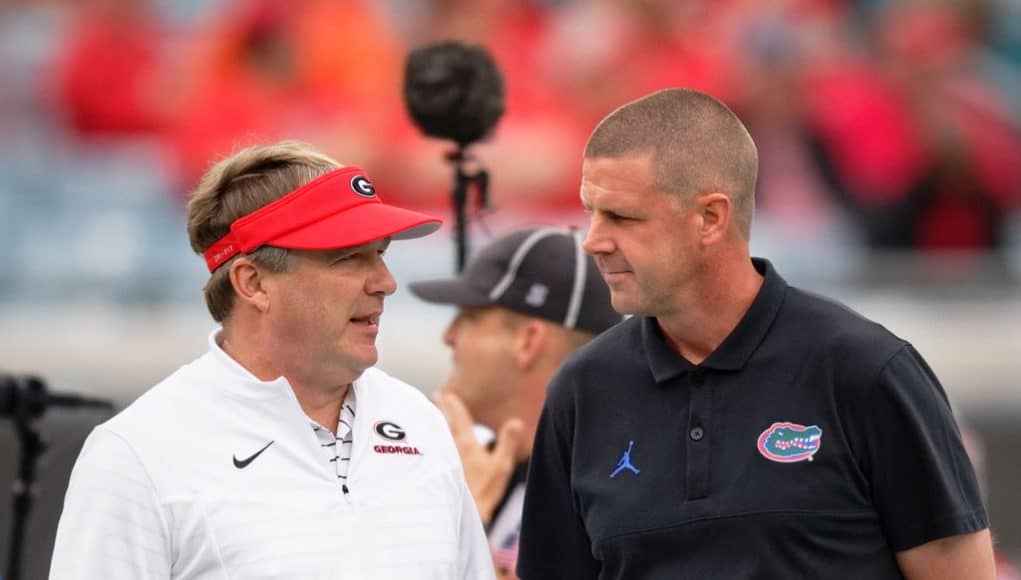
Florida (mercifully?) had an open date last week. That fact allowed you the Gator fan to survey the broader college football landscape, should you have taken the opportunity. It was quite the weekend for sitting back on the couch and not thinking much about the UF offense for a change.
Some things are so reliable that you can set your watch to them: James Franklin coming up excruciatingly short in a big matchup, or Mike Bobo driving every Georgia fan into a blind rage. It’s almost cozy to have those touchstones to rely upon.
However, the weekend also demonstrated how much of a limited commodity that consistency is anymore.
Take Florida State. Two years ago, the Seminoles went 13-1. Last year they went 2-10. This year, they kicked off the season by upsetting Alabama. Then on Friday they lost to a Virginia team helmed by Tony Elliott, a fourth-year head coach who failed to make a bowl in each of his first three.
Or look at how a week after getting waxed 63-10 by Indiana, Illinois beat USC 34-32. And how that Bama team that lost to FSU managed to beat UGA. And how Texas A&M outgained Auburn 414-177 and won the turnover battle 1-0 on the way to a mere 16-10 win. Or how a week after handily defeating Bill Belichick, UCF gave Kansas State its first FBS win on the season. Or how the Georgia Tech team that beat Clemson two weeks ago needed overtime to beat Wake Forest.
College football is the best in part because it’s so unpredictable. And it’s so unpredictable because the game on the field is generally played by young men between the ages of 18 and 22. Specimens of the type tend to range anywhere from inconsistent to outright volatile, and I know from once having been one once.
Nick Saban was the greatest ever because he got his team to show up and play hard every week without fail. It’s incredibly difficult to do that. Kirby Smart eventually won back-to-back titles, but his teams had no-show weeks every season leading up to it: losing 45-14 to 5-7 Missouri and to 6-7 Vandy in 2016, 40-17 to Auburn in 2017, 36-16 to LSU in 2018, to 4-8 South Carolina in 2019, and 44-28 to Florida in 2020. And then last year, he was back at it with a 28-10 loss to Ole Miss. Last year’s runner up Marcus Freeman at Notre Dame has a similar problem with losses to Marshall and a 3-9 Stanford outfit in 2022 and then famously to Northern Illinois last year.
It’s going to be even harder now because the era of the superteam is over. For quite some time, it was the case that the absolute best teams were the ones that recruited the best and/or had the most pro prospects. The exceptions, like 2010 Auburn, stick out because they were so rare. The closest thing to an outlier was Clemson, which became the de rigueur pick to play for the national title along with Saban’s Alabama for a while. That outlier status was only due to its recruiting rankings not being elite; Dabo and crew identified and developed talent as well as anyone in that span and churned out plenty of draft picks.
Ohio State last year may have been the last of the superteams, with an already elite roster being supplemented by a burst of transfer spending to put it over the top. Smart’s Georgia is still very good, but it doesn’t have bottomless depth everywhere anymore. Neither does Alabama, though it is under new management now. Clemson is struggling, LSU can’t get both its offense and defense good at the same time.
Between NIL and revenue sharing payments from the House settlement along with the fact that everyone’s a free agent every year, it’s incredibly hard to become incredibly good for longer than one season when all the stars align. Paying players and free transfers are the factors have eclipsed all else, perhaps no more visibly in the end of the facilities arms race.
Facilities just matter a lot less when players are getting six to seven-figure amounts per year to play ball. The football buildings and stadium still need to clear some reasonable bar to keep high school recruits interested, but transfer prospects simply don’t take campus visits. They usually hit the portal either already knowing where they’re going or with the intention of committing within a few days. Those 4K, HDR monitors with everyone’s names above the lockers just don’t pop as much when viewed over a compressed video chat.
There will be familiar names near the top of the rankings, such as the defending champs being No. 1 right now with Oregon not far behind. The plucky new challengers who haven’t sniffed the top of the polls in a while are… Miami (FL) and Oklahoma. Not exactly Cincinnati when it was getting ready to bust through into the four-team playoff.
But we still had Indiana, Texas Tech, Ole Miss, and Iowa State in the top 15 before the weekend’s festivities. All either won or were idle, so they will be moving up due to other teams losing. That’s another island of consistency, poll voters mechanically counting losses to decide where teams go each week.
To bring it back closer to home, this all means that Florida is never more than a couple of years out of serious contention. It also is never more than a year or two away from staring into the abyss, and with Mississippi State pushing Tennessee to the limit yesterday, little other than maybe Kentucky is looking all that sure from here on out in 2025.
But Florida is never more than a couple of years away, because no one who is well resourced is ever that far anymore. With a good hire and the absence of penny pinching the likes of which haven’t been seen in Gainesville in quite some time, no one in the SEC or Big Ten is incapable of getting good quickly. Nailing the good hire is quite difficult, with even some assumed slam dunks like Lincoln Riley to USC not working out quite as well as anyone thought. Brian Kelly’s offense is struggling so much that, lest we forget, DJ Lagway threw five picks against his team and the Tigers still only won the offensive-points battle 13-10.
More parity means margins are naturally slimmer and therefore luck, chance, randomness, variance, or whatever you want to call it can take more control. Therefore, it will be the coaches who try to find every edge and press every advantage who will thrive the most. What UF needs most is either for Billy Napier to find it in himself to become that kind of coach or else make room for someone who will.