

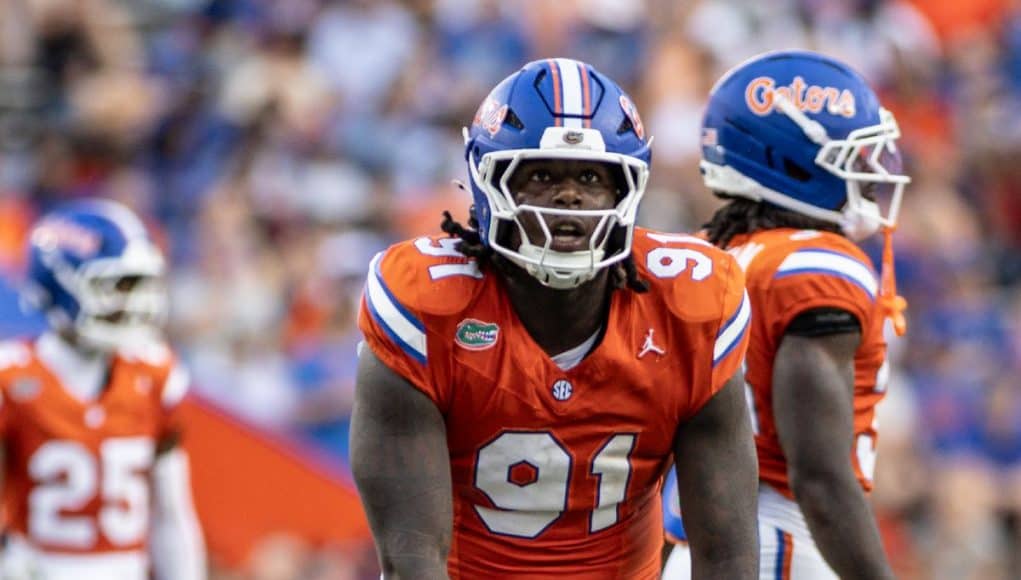
Florida will line up Saturday in what will feel like a jigsaw puzzle of a reunion. It’ll be only the Gators’ fifth game against Auburn since the annual series against the closest SEC team to Gainesville ended after 2002. It will also be against new Tigers head coach Alex Golesh and quarterback Byrum Brown, who together led USF to victory in what will probably be the Billy Napier-era loss that stings the most for UF partisans.
This being the first seasons for both head coaching regimes, we don’t have a lot to go on. Both teams a year ago were squads with uninspiring at best offenses and solid (Florida) to good (Auburn) defenses. Golesh’s offensive pedigree plus some key transfers were supposed to reignite the attack on the Plains.
Through two games, which again is a very small sample size, it’s a work in progress. Auburn got things going in Week 2 by smoking Southern Miss 43-8, but it had a real hard time in its 17-16 opener against Baylor. Florida, of course, hasn’t faced anyone near as good as the Bears from Waco, breezing to a pair of easy victories no matter how uneven they were at times.
Before considering if Golesh has UF’s number, he doesn’t. He was 1-1 as offensive coordinator under Josh Heupel at Tennessee, the loss being a 14-point performance against Todd Grantham’s 2021 defense. And while his offense got to 38 points in a rare Vols win in 2022, three other teams scored more points on the Gators in that season.
It’s also worth remembering just how much effort that two-point Bulls win required a year ago. They got merely 18 points despite gaining 391 total yards. UF kicked a second quarter field goal on a drive that had two different touchdowns wiped out by penalty. USF’s only touchdown came on a deep 66-yard pass during which two Gator defensive backs ran into and knocked each other down right as the receiver made the catch. The final margin stems directly from a safety over the punter’s head from Florida’s 3rd team All-SEC long snapper. It really did take all that and more.
One measure of effort I like to use from time to time is yards per point (YPP). It is what it sounds like: take yards, divide by points. It’s a rough estimate of how hard a team had to work to get its score, or vice versa. Offensive YPP is better if it’s lower; defensive YPP is better if it’s higher. Finishing drives with scores, short fields, and non-offensive scores are some of the things that drive the number down and either show an offense succeeding or getting some help from other phases of the game.
South Florida’s 18 points on 391 offensive yards comes out to 21.7 yards per point. That’s a terrible number. They had a number of long drives, but most ended in field goal attempts. One of those attempts was a miss, too. They had to work extra hard to get the meager point total they had.
For the other end of the spectrum, consider Florida’s offense in the opener against FAU. Did it look effortless? Sure did. And indeed, the Gators had 66 points on 624 total yards for 9.5 YPP. If you can get that figure under ten, your offense had a great day. The follow-up against Campbell wasn’t as pretty, but two punt return touchdowns from Vernell Brown III made up for it. UF’s YPP in Week 2 was 9.9 thanks to 52 points on 514 yards. Had the game been in any doubt whatsoever, those two punt return touchdowns would’ve taken real pressure off of the offense to have to score as often.
In two games, Auburn has yet to put together a performance that looked so easy. The Tigers’ 43 points against Southern Miss required 613 yards to get there, a YPP of 14.3. That’s even a little higher than Florida’s figure from last week if you take the special teams scores out. A Tiger fumble lost near the goal line and a garbage time turnover on downs for with the backups in will do that.
In the one game either of these teams has played against a P4 foe, the YPP figure will sound familiar. AU got to 17 points after gaining 389 yards, which is 22.9 YPP. That’s pretty close to USF against Florida last year. Three turnovers, a turnover on downs, and a missed field goal will give a team a pretty rotten number. The thing that saved the Tigers was Baylor’s own follies, as their 16 points came on 436 yards (27.3 YPP). The Bears also had four combined turnovers and turnovers on downs plus a missed field goal. They had one extra scoring drive versus Auburn, but one touchdown and three field goals will lose to two touchdowns and one field goal.
If the Gators’ offensive line can hold off Auburn’s pass rush long enough for Aaron Philo to find targets, Florida should be in good shape. UF has a matchup advantage with its receivers versus the Auburn secondary, and Philo has looked terrific so far. He’s poised, moves well in the pocket, and throws an accurate, catchable ball.
I don’t expect Florida to have a ton of success on the ground other than when Jadan Baugh makes some of his routine highlight plays (yes, that’s phrased correctly). Auburn has a good defensive front that gave Baylor a lot of problems, and I have a hard time believing based on what I’ve seen so far that the Gator offensive line is something more than average. It’s not 1982 anymore and you can win with throwing more than running, and Baugh and the occasional rush from Philo may be just enough to supplement the passing attack.
Really, the Gators need to not make things hard on themselves with bad penalties like in the second half last week or giving up too much easy yardage as in Week 1. Nothing about Auburn’s performance is going to look effortless on its own. The best path to a win is for Florida is to keep it way.