

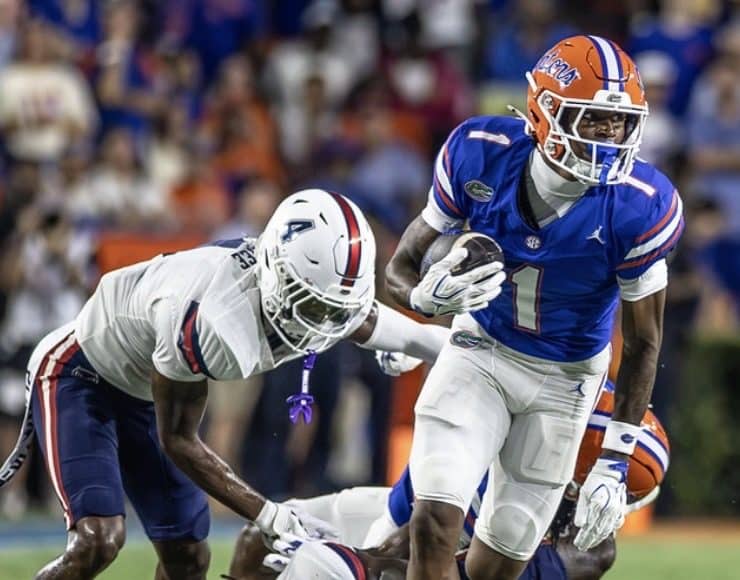
Here’s the good news: there was nothing fluky about Florida’s win over FAU on Saturday.
Here’s the bad news: there was nothing fluky about Florida’s win over FAU on Saturday.
Let’s start with the good part. The Florida offense was every bit as dominant as it seemed against the Owls. To drive the point home, I’m going to juxtapose it with a comparatively fraudulent big opening win, that being UF’s 65-0 win over Eastern Michigan to start 2014. As a bonus, that was Kurt Roper’s first game as offensive coordinator, so we have two different OCs’ first games to look at here.
A long time ago, I made a video about success rate if you want the details. Basically, it’s a measure of how well a team stays on schedule. Or in a defense’s case, stops the offense from being on schedule. The national average for success rate is typically around 42%, or at least it was the last time I checked years ago.
If a team rushes for a three-yard gain on first down, throws an incompletion on second, and then picks up the conversion with a ten-yard pass on third down, that’s only a good set of downs in that they moved the chains. Given the choice, you always want to move the chains. However the short gain on first down and no gain on second means that set of downs only had a 33% success rate.
Fair enough, no offense ever stays on schedule completely no matter how bad the defense. However over the long haul, a 33% success rate is subpar and will result in a team having a hard time scoring.
In that linked video above, I used Florida’s win over Eastern Michigan game as an illustration of the usefulness of success rate. Prior to garbage time (defined as a lead of more than 24 points in the second quarter, more than 21 in the third, and more than 16 in the fourth), Jeff Driskel had a completion percentage above 80% but a sub-30% success rate on his passes. If that was his success rate against EMU, could he really do much better against SEC teams? (Spoiler: he couldn’t.)
To do an apples-to-apples comparison, let’s talk about Aaron Philo in the pre-garbage time action against FAU. That covers the entire first half, as UF never led by more than 24 before the break and never less than 21 after.
In success rate terms, eight of his 15 passes hit the mark. That’s a 53% success rate, which is not just well above Driskel’s rate but well above average too. You could call it 8-for-14 for 57% if you want to discard the interception that went through a receiver’s hands.
The website Game on Paper turns ESPN box scores and play-by-plays into advanced stats, and it shows another difference (albeit without garbage time adjustments). The 2014 EMU game had UF with a 49% success rate for the whole game, versus 58% for the FAU game. If you prefer expected points added, the 2026 Gators had a figure of .59 against a mere .31 for the 2014 Gators. Long story short with that one, the results would predict last Saturday’s offense to outscore that of a dozen years ago by about 13 points despite Roper’s attack running 86 scrimmage plays versus Buster Faulkner’s 67.
If that’s too much mathy-talk for you, the bottom line is that the Florida offense on Saturday truly had a terrific game. There was nothing mirage-like underneath similar to what you could find from Roper’s offense in 2014 despite there being a single point separating the two teams’ outputs.
The flip side is that success rate shows that FAU’s offense really did move the ball as well as it seemed on Saturday. That wasn’t a mirage either.
The Owls had a 47% success rate over the whole game, which is also above the national average. They easily could’ve scored more points if not for Florida generating some turnovers of its own. Eastern Michigan had a success rate of 35% in that 2014 game, if you’re curious of the comparison. It also had an EPA per play well into the negative numbers, whereas FAU’s was slightly positive.
Jon Sumrall was ornery about the way his defense was playing in every in-game interview Saturday night. He was still ornery about it after the game too, calling the defense “atrocious at times“.
Brad White spent his Tuesday press conference talking about all the stuff that went wrong too: being put on the back foot by tempo, lacking line play, poor communication and awareness, and more. There is plenty to work on this week.
The good news is that neither Sumrall nor White tried to act like the defensive performance wasn’t that bad even once. Zero excuses, zero defensiveness. White put the burden on the coaches to fix things, citing inadequacies in the way he trained up the players to be ready for different down-and-distance situations.
If we’re still seeing corners a mile off the ball on short yardage in November and Sumrall giving press quotes that could be construed as sounding like he doesn’t have a way to talk to his defensive coordinator, then we’ll know there are some pretty deep problems. We’re only one game into this season, so we have to wait and see about improvements.
The offense really was that good. The defense really was that iffy. The Gators now get one more tune-up game before garbage time will cease to be much of a concern in the stats.