

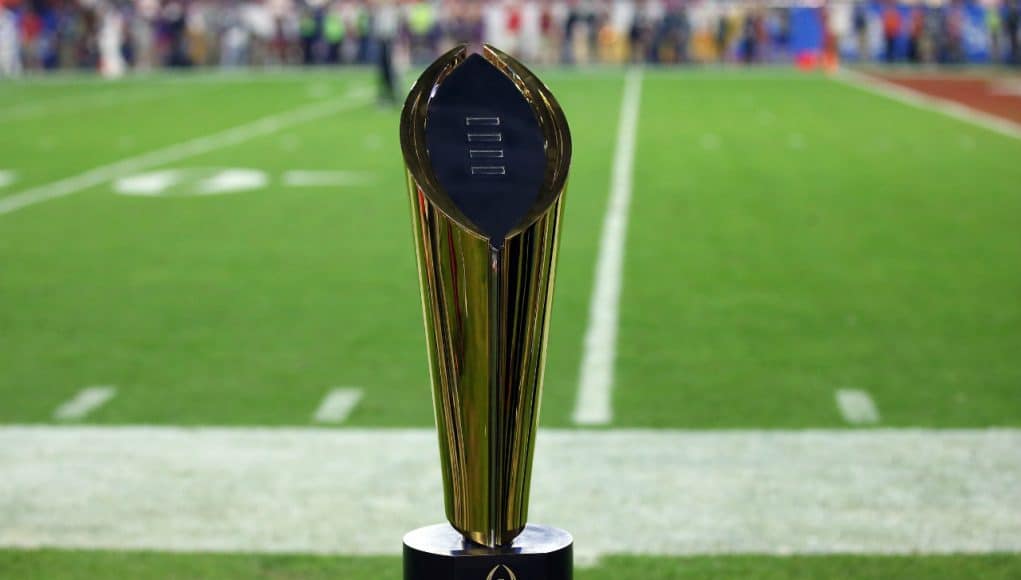
Scott Stricklin made his annual visit to the Gator Nation Football Podcast this week. Among other things, he spent some time talking about his views on potential College Football Playoff expansion.
Stricklin, while doing his best not to undercut the SEC’s stated position on the playoff, indicated he wants to see the playoff field expanded. He drew some parallels to how postseason tournaments are sized relative to the leagues that play them. Without putting a flag in the ground on a particular number, he wants to see a format large enough that the SEC would reasonably be able to put seven teams in the field in a year (provided there are at least seven quality teams in the conference in that season).
The last column I wrote here was about the push that everyone outside the SEC is making for a 24-team field. A lot of coaches and athletic directors are on the same kind of wavelength, as their key word is “access”. They want more access to the postseason for their own reasons: coaches, because they think they’ll have more more job security if they make the playoff and therefore more slots means more chances to make it, and ADs, because they want a better shot to make the playoff to justify all the money they’re spending on their programs.
The television broadcasters of course want more spots in the playoff because they want more inventory. If the format expands beyond 14, then the extra games go out to bid and a competitor like Fox Sports would be able to try to break ESPN’s monopoly on the playoff. The Worldwide Leader has and will continue to sub-license games to TNT, but they’re still ESPN’s thing to manage. Fox and probably the other over-the-air networks would like to get in on it, and who knows, maybe some streamers too.
I have also seen the case made, most prominently for me by Andy Staples and Ari Wasserman on their Andy & Ari On3 podcast, suggest that expanding the playoff beyond 12 teams might make increasing sense in the post-NLI and revenue share world. The talent field is flatter than its been in a long time, since powers can’t stack high end talent three-deep anymore like the Saban Death Star teams did and Kirby Smart did at Georgia half a decade ago. Why wait your turn when you can make more money and play somewhere else and then still transfer up to a blue blood if you’re good enough?
All of these rationales are missing a central consideration: what is the point of a postseason tournament?
The answer in most cases is to crown a champion. You’ve decided that the regular season is insufficient to determine who gets to raise the trophy, so you stage a postseason format to decide.
This historically can make a lot of sense. When you’re Major League Baseball back in the day and the American and National Leagues don’t play each other, you need to have a World Series to pick a champion between them. When you’re college basketball and there are way too many teams to have enough connection between all of them in the non-conference to choose the rightful champion, you stage a tournament to decide it.
College football resisted the siren call of a tournament for a very long time. The champion in any given year was whoever you wanted it to be. Sometimes it was relatively clear cut, because someone went undefeated and finished at the top of both the AP Poll and Coaches Poll. Sometimes it was less clear cut and the title was split between those polls. And then other publications might pick their own, different title winner. If you asked the New York Times, Florida was your 1984 national champion.
But no matter which source you were looking to for your champion, being the champion meant the same thing: being the best team. You were looking to see who a panel of writers, or a panel of coaches, or whoever else decided was the top team in that season.
In college football, being the national champion was synonymous with being the best team.
In tournaments, the best team doesn’t always win. Sometimes you get a barely above-average New York Giants team winning the Super Bowl over an undefeated New England. Sometimes the No. 1 overall seed in March Madness doesn’t make it past the first weekend. So it goes. The champion for those sports is who wins the championship game, not who is the best team.
College football used to be able to have it both ways.
The first college football championship models — the BCS and its predecessors the Bowl Coalition and Bowl Alliance — pitted the top two teams. Usually. The pre-BCS formats didn’t include the Big Ten or Pac-10, and the BCS formula didn’t always produce a unanimous No. 1 vs. No. 2.
The expansion to the four-team playoff was a way to include more teams, because picking the top two was not always easy without the benefit of hindsight. And then sometimes there’d be times like in 2012 where most every agreed that you couldn’t keep undefeated Notre Dame out of the title game, even though they were likely to be grease-spotted by Alabama. Opening things up to four would solve some of those problems.
The four-team format ran into a problem right away in its first season because of how it handled 2014 Ohio State vs. TCU vs. Baylor. Then even though the committee made what I think was the right choice in leaving the Jordan Travis-less 13-0 FSU team out in 2023, it made a lot of people very mad. Expanding beyond four, especially considering there were five power conferences at the time, was another tactical retreat.
We got to 12 in the playoff around the time we lost one of those five power conferences, but now at least there wouldn’t be any question of whether the best team would be included. It beggars belief that the best team wouldn’t make the top 11 or 12 of the committee rankings. Even if you’re one of the few still convinced that a non-power conference team might end up being the best team, pre-Big 12 Cincinnati made the field in the four-team format. The actual best team not making the 12-team field simply won’t happen.
Even those like Staples (less so) and Wasserman (much more so) cracking the door open for a larger field on account of greater talent dispersion, the thing they keep repeating is that it is conceivable that a team seeded worse than 12 might be capable of winning the playoff tournament someday.
That’s not the same thing as saying the best team might be seeded worse than 12. As I just said, there’s no chance it will be. Being capable of winning a tournament is very much not the same thing as being the actual best team.
Sometimes the best team will lose in a tournament. It could even happen in a two-team tournament like the BCS Championship Game. Multiple college football title game winners have been teams avenging earlier losses, like 2011 Alabama and 2021 Georgia. Whether you think those champs were the best teams or not, they proved their ability to lose to the very teams they defeated to take home the trophy.
But the more games played in the tournament, the more likely it is that the best team won’t win the title. Expanding the college football playoff will increase the chance of that happening — especially in light of the talent field becoming more level. As the margins between the best team and the next few teams get smaller, the best team will have a harder and harder time winning the playoff.
If you care about keeping alive the college football tradition of striving to have the best team named champion, you must be against further College Football Playoff expansion. I lean that way myself.
However, I see stakeholder after stakeholder abandoning it, which makes me sad. I can see which way the wind is blowing. It’s yet another aspect of the game that goes back long before I came around that will soon go by the wayside. As the sport becomes more and more a mere product, the more its oddly shaped parts will be sanded down to fit in a neat box. I can only hope they won’t all get that treatment.