

Florida’s offseason got off to a tremendous start when it was announced that Alex Condon would return to Florida for his senior season, something that wasn’t seen as a certainty given how he would likely see his name picked (perhaps in the second round) should he have attempted to turn pro. Throughout his time in Gainesville Condon has become a fan favorite for his hustle, physicality, toughness, and ability to score in transition, and he will enter the 2026-27 season as one of the best frontcourt players in the country.
Looking at what he did well, and what he’ll look to improve on in his senior season, all starts with the pressure he puts on the rim. This starts in transition where he can run like a gazelle, beating his man down the court and often getting free layups before the defense is set. Even if his defender remains in stride, Condon can then use his strength to pin his man on the top side, allowing for the lob over the top that often ends in a thunderous dunk. Condon’s ability to rebound the ball and still beat his man down the floor was one of his most underrated attributes given how important the transition game was to the Gators and how pivotal Condon’s role was within the structure. Not only did he often start the break with a big board and an immediate kickout, he was still somehow the first player down the court in a number of settings.
When things slowed to the halfcourt game, Condon was someone who was one of the better individual creators on a team that didn’t have a ton of them. No, he wasn’t someone who was going to start dribbling his man down from behind the three-point line and start operating like a point guard, but any time things got stale the Gators could throw it inside to him where he has become a very capable one-on-one post scorer. This year Condon shot 63% from inside the arc, a major increase from the season prior where he was 54% (a good number to begin with) and he did it while drastically increasing his usage which is not easy to do. The mid-post was also the area where Condon operated most as a passer and accumulated many of his assists. For a good chunk of the season the Aussie big man actually led the Gators in assists and while Xaivian Lee was able to surpass him Condon still finished second on the team with 3.6, an outstanding number from a forward.
At this point, you might be thinking about the tradeoff of Condon’s passing being his many turnovers–and this will be something he looks to improve on this upcoming season. His 2.4 turnovers per game and 18.7% turnover rate paints the picture of someone who was a little bit loose with the ball, and though many of these plays were poor decisions or execution there is a case that he was put in some tough spots. It was often Condon left trying to salvage a possession late in the clock with his back to the basket, with Florida’s team struggles overall falling on his lap to try and make something happen with a floor that wasn’t well spaced and with minimal movement or action. The poor spacing also meant that when Condon beat his man with the drive he immediately was met by Rueben Chinyelu’s defender who would be parked in the lane ready to swallow up the drive.
Perhaps this brings up one of the biggest talking points surrounding Condon going into 2026-27–will he get to play more center, and should he. The Gators are still waiting on Chinyelu’s decision to stay in the draft or not, and even if he returns there has been discussion with Florida’s staff about trying to get Condon more minutes at the 5. Given how Condon’s biggest strength is his ability to put pressure on the rim, that advantage would be much better leveraged with him at center. Going through the film, many of Condon’s excellent individual plays were negated by the poor spacing of him playing next to another “5” who would be camped out in the lane, and this was evidenced even more in the pick and roll game. Florida loved to involve Condon as a screener, as his quick first step down the lane would make him a dangerous rolling threat and he also had the hands to catch and finish in the lane. However, since Florida would have Chinyelu sitting in the dunker spot, many rolls to Condon were completely negated. You might even remember the now infamous play in the NCAA Tournament when Condon got tied up with Iowa’s Alvaro Folgueiras–well, if you go back and look at it, the initial contact and subsequent frustration came on a play where the Gators had Condon on a roll but he was frustratingly ran into by Chinyelu’s defender due to the Gators’ poor spacing.
Since Condon is so dangerous in the pick and roll game and is someone who can take advantage of slower defenders facing up, it’s quite clear he would be better used as a center, though how the roster takes shape around him will inform the rotation.
Putting Condon at the “5” also would allow him to be the primary rim protector, and this is an area where he thrives. Condon’s foot speed, length, and anticipation has made him a tremendous shot blocker and he is fearless going up against SEC athletes who have tried to dunk on him–with most ending up rejected. Condon was 218th in the country in block rate last year, and you have to wonder if that number could go up even more if he ended up playing more center where he’d be in more positions to use those shotblocking abilities.
Whether it be for the success of Florida or Condon’s pro prospects, an improved three-point shot would be something everyone would love to see. After shooting 29% from three as a freshman and 33% as a sophomore Condon had some buzz as a stretch big, but that came crashing to a halt last year where he shot 17% from three and 15% in SEC play, getting to the point where teams wouldn’t guard him behind the arc at all and instead dare him to take open looks. To get a deeper look at his shooting struggles I wanted to really dive into the different attempts and where they came from, and in doing so found something pretty surprising.
On straight on threes (think of the lane lines extended), Condon shot 24% from three.
From everywhere else combined, he shot 0-17. 0%. The corners, the wings, zilch.
Seeing these stunning results, I decided to go back to his sophomore year:
Straight on threes: 33%
He did shoot 4-10 on left wing threes, and then 1-4 from everywhere else.
Finally, as a freshman:
37% on straight on threes, and 10% on everything else.
Okay, I am pretty sure you can see what I’m getting at–Condon can shoot the straight on three, but he has really struggled from the corners and wings. Playing center, Condon would have more chances at straight-on threes while playing the trail spot or picking and popping, though having him as the “4” will make for more wing threes where he isn’t as comfortable.
Hopefully Florida’s staff has taken note of some of these shooting numbers and will make wing and quarter threes a focus of his shooting development, while also thinking about ways to get him the threes he is more quality at making.
Even if Condon doesn’t become an average or above average shooter, the other elements he brings makes him one of the best frontcourt players in the country and it seems like if he regained the jumper it would just be the cherry on top for someone looking to be an All-American. With Alex Condon and Thomas Haugh returning, a push for another Championship is a clear goal for the Gators.
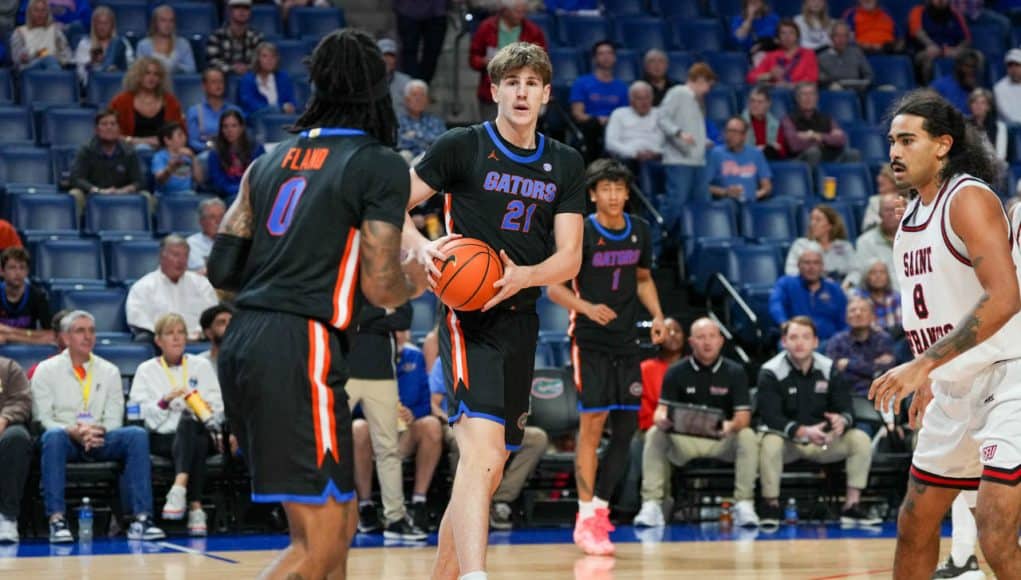
Florida Gators forward Alex Condon (21) during the game against the Saint Francis Red Flash at Stephen C. O'Connell Center on December 17, 2025 in Gainesville, Florida. Gator Country Photo by Kan Li.