

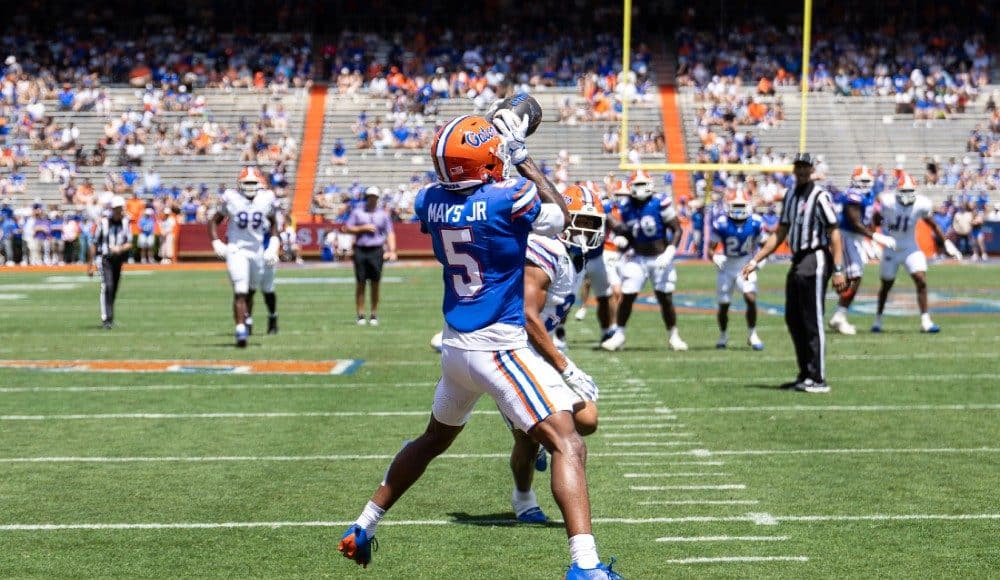
With both the offense and defense trading blows in a spring game featuring a unique scoring system, the matchup ended in a 45–45 tie. There was a mix of positives and negatives, which is to be expected from a team that has practiced just 15 times after adding 50 new players this offseason.
Both coordinators admitted postgame that they weren’t using the full playbook. Florida’s offense relied primarily on base concepts, while the defense showed little beyond a four-man rush, making it difficult to fully evaluate where the team stands based on one game.
That said, there were several standout performances as well as areas in need of improvement. Gator Country breaks down five takeaways from Florida’s Orange and Blue spring game.
Florida’s wide receivers shined
We’ve heard all offseason about Florida’s wide receivers—their talent, speed, and game-changing ability—and we saw it all on full display Saturday afternoon. Even without Dallas Wilson, the Gators’ receivers shined.
Wake Forest transfer Micah Mays Jr. stole the show, hauling in four passes for 122 yards and two touchdowns. He broke free for a 75-yard score on a slant-and-go route, catching redshirt senior cornerback Jordy Lowery flat-footed before pulling away. After securing a perfectly placed pass from Tramell Jones Jr., there was no catching him.
Mays Jr. later added his second touchdown of the game on a 23-yard reception from Aaron Philo, finding a soft spot in the middle of Florida’s zone defense.
Auburn transfer Eric Singleton Jr. had six receptions for 92 yards and a touchdown. He was utilized in both the quick passing game and vertical routes. Redshirt sophomore TJ Abrams caught six passes for 56 yards, including an impressive off-balance 35-yard grab in which he created separation and fought back to a slightly underthrown ball. Vernell Brown III added four catches for 47 yards and a score and likely could have had an even bigger day with a couple of more accurate throws.
Florida’s wide receiver room stacks up with any in college football, which should make life easier for the quarterbacks.
Quarterbacks start slow, end fast
All eyes were on the quarterback battle between Aaron Philo and Tramell Jones Jr., who received seven and six drives, respectively. Both quarterbacks struggled out of the gate, failing to move the ball down the field. I don’t think the screen heavy play calling was helping, but Philo also missed a few deep shots early in the game. Both settled down as the game progressed and finished up a high note.
Through 29 minutes and 16 seconds of game action, Florida’s offense had just one touchdown, a beautiful 38 yard play action touchdown pass from Tramell Jones Jr. to Eric Singleton Jr.
The Gators proceeded to score three touchdowns in the final 44 seconds of the first half. Yes—you read that correctly, three touchdowns. It started with a 33-yard touchdown pass from Aaron Philo to a wide-open Vernell Brown III. Tramell Jones Jr. responded with a beautiful deep ball to Micah Mays Jr. for a 75-yard touchdown on the first play of the next drive. With 31 seconds remaining, Philo connected with Eric Singleton Jr. on a chunk play before finding Mays Jr. in the end zone for a score with nine seconds left on the clock.
Jones led a field goal drive on the opening possession of the next half, and that was it for both quarterbacks.
Philo completed 21 of 28 passes for 193 yards, two touchdowns, and two interceptions. Tramell Jones Jr. went 13 of 17 for 210 yards and two touchdowns. Neither really separated himself, though the day goes to Jones Jr.
Offensive line needs more improvement
Similar to the quarterback play, the offensive line settled down as the game progressed, but the unit is clearly not the strength of the team. The defensive line won the line of scrimmage more often than not, recording five sacks and 10 tackles for loss over 122 snaps—roughly two games’ worth of work. Of course, defenders weren’t allowed to fully hit the quarterbacks, so that number could have been higher.
Florida averaged just 3.1 yards per carry on the ground and didn’t generate much push up front. In its defense, Florida rotated heavily along the offensive line in an effort to identify its best starting five. The Gators also attempted 77 passes, signaling a clear emphasis on evaluating pass protection. As noted earlier, the offensive line settled in late in the first half and performed better during the scoring stretch.
Jon Sumrall indicated postgame that the team must improve this summer or it will have “no chance.” Offensive coordinator Buster Faulkner added that it is the most improved group since they arrived.
Defense allowed explosives but was otherwise sound
Florida’s first and second team defense dominated for a majority of the game but simply allowed too many explosives. Easier said than done when going up against a wide receiver room as deep and talented as Florida’s, but the cornerbacks got beat on a number of double moves.
Outside of the chunk plays allowed, there were plenty of positives. The front seven played well, filling run gaps and showing physicality in the trenches, while the secondary did a solid job of flying to the ball on quick screen passes. The effort was there.
Florida’s defensive backs flashed at times as well. Cormani McClain had a strong break on the ball and deflected a pass. Kanye Clark was physical in run support and blew up a screen pass. DJ Coleman made a strong play in the box to come away with an interception. Cam Dooley also recorded an interception, though it was more a case of being in the right place at the right time. Onis Konanbanny secured Florida’s third interception with perfect coverage against Marquez Daniel. Konanbanny was tasked with matching up against Florida’s most physical pass catchers, and he did an excellent job.
Disciplined performance with just five penalties