

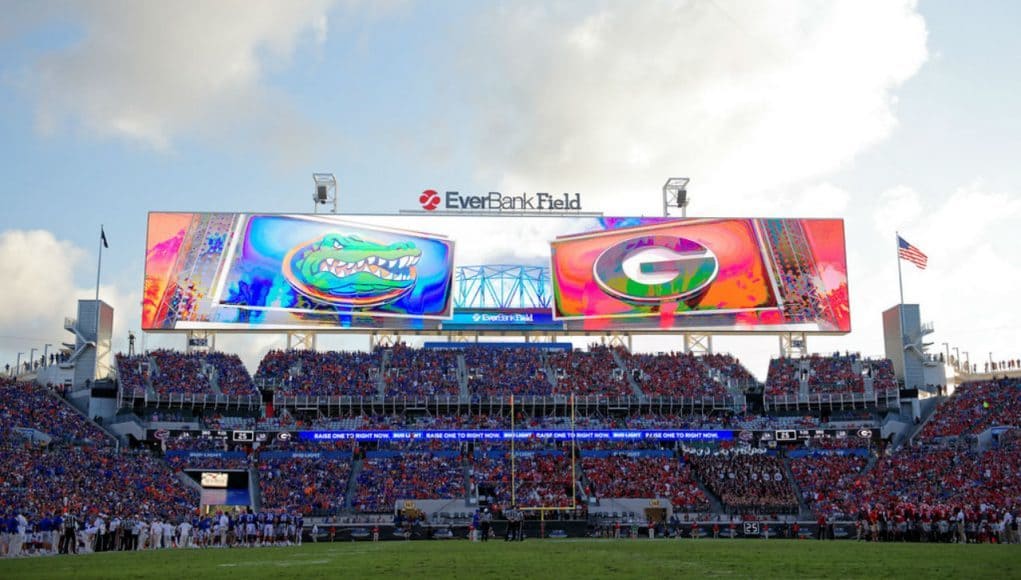
The SEC announced that it will finally acquiesce to logic and go with a nine-game conference schedule beginning next year. From the league:
Under the new format:
The requirement to annually play at least one ACC, Big Ten, or Big 12 team, or else Notre Dame, still exists.
The additions of Oklahoma and Texas required a new scheduling arrangement. Instead of getting something made up right away — and despite there being years between the announcement of the Sooners and Longhorns coming in and them actuallly arriving — the league repeated what it did when it added Texas A&M and Missouri: do two years of stopgap scheduling. The 2012 and 2013 schedules were hand-crafted before a rotation began in 2014. The 2024 and 2025 conference slates were even more handcrafted since divisions went away at the same time, though Birmingham made it easier on themselves by having them be the same except with the game sites flipped.
The question was always whether it was going to be a eight-game schedule with one permanent and seven rotating spots or a nine-game schedule with three permanent and six rotating spots. Mathematically, those are the only two options that work within the traditional constraints of a college football schedule. A slate of five permanent and five rotating teams would work too, but the league was never going to a ten-game schedule because of non-conference rivalries and the near-universal desire to have a couple of cupcakes for fun and fundraising.
The league didn’t announce what each team’s permanent rivalries will be, but there is no indication that this will be a pod-based arrangement. Pods would be where there are four groups of four teams that all have each other as their annual opponents within each group, but the goal of preserving historical rivalries won’t allow that.
After all, the reason I have mostly been expecting a nine-game schedule (unless the SEC really wanted to play financial chicken with ESPN) is that there are teams with multiple important historical rivalries. The teams that share a state with the league office each have two: Bama and Auburn have the series between themselves along with major rivalries with Tennessee and Georgia, respectively.
Here is how I would go about building a list of annual series to predict how the conference will end up.
Named Series
If a rivalry is so important that it has a well-known name, it will be a permanent series in this new format. These would qualify:
- Iron Bowl (Alabama-Auburn)
- Third Saturday in October (Alabama-Tennessee)
- The Deep South’s Oldest Rivalry (Auburn-Georgia)
- The World’s Largest Outdoor Cocktail Party (Florida-Georgia)
- Egg Bowl (Ole Miss-Mississippi State)
- Red River Rivalry/Shootout (Oklahoma-Texas)
Tennessee-Vanderbilt and Texas-Texas A&M don’t have famous names, but they’re in-state series so I put them in this level of importance as well.
Notably not here is the Battle for the (Golden) Boot, the series between Arkansas and LSU. It has a somewhat famous name and a dangerously sharp and heavy trophy, but my understanding is that neither fans base feels as strongly about it as the others listed here. Therefore, it’s not in this top tier of rivalry.
Reviving old conference tilts
The SEC loves history, and there are the pre-Big 12 series between Arkansas and the Texas schools (Southwest Conference) as well as Missouri and Oklahoma (Big Eight) that can come back. I don’t think the league is all that concerned with Big 12-only series like Missouri or Oklahoma playing Texas A&M, and I don’t think it should be.
Very long-lived series
The conference has some games that have been played an enormous number of times. The Auburn-Georgia rivalry lives up to its name, having been played 120 times already.
Plenty other series have happened more than 90 times, and those should be preserved where possible. Not all can be — Mississippi State alone has four such series — but these could (hat-tip to Chris Stassen for data here):
- Auburn-Mississippi State (97 games)
- Kentucky-Tennessee (107)
- Kentucky-Vanderbilt
- LSU-Ole Miss (107)
- LSU-Mississippi State (114)
- Ole Miss-Vanderbilt (94)
That only leaves only Alabama-Mississippi State (106 games) on the cutting room floor, but something involving the Bulldogs had to be there. There are other series that passed the 90 mark that were already listed in other sections above, so that’s why they’re not mentioned here.
Border conflicts
If you’re counting along at home, South Carolina has yet to be mentioned. It wasn’t an original SEC school, and it has no prior history with any of the other newer members. So, I’m giving them Georgia so that they have something close by.
I could save the Golden Boot series here as an annual concern, but I’m going to skip that in favor of keeping LSU-Texas A&M and Arkansas-Missouri instead. I think those have panned out fairly well, and the Golden Boot will be played every other year anyway. That fact, that the league will make sure everyone plays everyone else in any given two-year span, really takes the pressure off once you get this far down the list.
What’s left
Some heavy hitters still have open spots on their dance cards. Your fightin’ Florida Gators are among them, but so are Alabama and Oklahoma. Kentucky, Missouri, and South Carolina do too. How do you want to do this? Make a Bob Stoops Series between UF and OU? Or put the dominant teams of the 2010s Big 12 and SEC and have Alabama and Oklahoma every year?
For the sake of completing something here, I will do the latter of those to give the conference a cornerstone matchup to highlight its upgraded power. I’ll also keep the battle of Columbias, since those have been interesting, and then round it out with Florida and Kentucky continuing on. Here is my lineup:
| Team | Rival 1 | Rival 2 | Rival 3 |
|---|---|---|---|
| Alabama | Auburn | Oklahoma | Tennessee |
| Arkansas | Missouri | Texas | Texas A&M |
| Auburn | Alabama | Georgia | Miss State |
| Florida | Georgia | Kentucky | South Carolina |
| Georgia | Auburn | Florida | South Carolina |
| Kentucky | Florida | Tennessee | Vanderbilt |
| LSU | Ole Miss | Miss State | Texas A&M |
| Miss | LSU | Miss State | Vanderbilt |
| Miss State | Auburn | Miss | LSU |
| Missouri | Arkansas | Oklahoma | South Carolina |
| Oklahoma | Alabama | Missouri | Texas |
| South Carolina | Florida | Georgia | Missouri |
| Tennessee | Alabama | Kentucky | Vanderbilt |
| Texas | Arkansas | Oklahoma | Texas A&M |
| Texas A&M | Arkansas | LSU | Texas |
| Vanderbilt | Kentucky | Miss | Tennessee |
What do you think?
I think that the only sure thing is that someone is going to be very mad about all this. Probably lots of someones. LSU gets both Mississippi schools and Tennessee gets both Kentucky and Vandy, while Bama gets three teams with national titles in the last 30 years in Auburn, OU, and Tennessee. UF gets two from the traditional underclass in Kentucky and South Carolina, while UGA gets two teams with national titles in the last 20 years in Auburn and UF.
The saving grace is, as I said above, that everyone will play everyone else frequently enough that it should all even out. It won’t be like the 2014-23 rotation where you might play a school one year and then not see them again for a decade. No one will be ducking anyone for long.
But hey, in the SEC, it just means more. More of just about everything, anguish over unfair, rigged, illogical, preposterous scheduling included.
I’d much prefer Awbrin than kentucky,
Jawja, Awbrin and the usc that ain’t would be nice, imo